The Amazon Scaling Framework: Breaking Through $10K, $25K, and $50K Monthly

Here's some full transparency about scaling an Amazon business: each revenue milestone requires fundamentally different systems. The operations that work at $5K monthly will actively hold you back at $15K. And the strategies that got you to $25K? They'll choke your growth at $40K.
The pattern is consistent across the industry. Brands work harder than ever, advertising spend increases, but revenue just won't push past that $12K or $28K mark. The real issue? They're trying to scale by doing more of the same instead of recognizing that each growth stage demands entirely new infrastructure.
But here's what our team has learned from working directly with Amazon sellers: successful scaling isn't about random tactics or working longer hours. It requires a partnership approach where we work together to build the right systems at the right time, so your business can handle each new level of complexity without breaking down.
In this guide, I'll share the proven scaling framework we use to help growing brands navigate through the $10K, $25K, and $50K monthly milestones. You'll learn exactly what systems you need at each stage, understand when DIY approaches stop working, and discover which investments actually deliver ROI versus which ones just drain cash.
Most importantly, we'll have an honest conversation about what sustainable scaling really requires, the specific bottlenecks you'll face at each level, and how to calculate whether professional partnership makes financial sense for your situation.
Why Each Revenue Level Requires Different Systems
The biggest mistake? Treating scaling like a linear process. Brands think if something works at $8K monthly, they should just "do more of it" to reach $20K. But Amazon doesn't work that way.
Each major revenue threshold introduces new operational complexity that requires fundamentally different approaches. Miss this, and you'll spend months wondering why growth suddenly stopped.
The $10K Ceiling: At this level, your time becomes the bottleneck. You're still handling everything yourself because hiring seems expensive. Every hour spent on customer service or updating listings is an hour you can't spend on strategic growth activities. The business can't grow beyond your personal capacity.
The $25K Ceiling: Now it's your systems that are failing. You've probably hired some help, but nothing is documented. When your VA has a question, they interrupt you. When inventory runs low, you scramble. When advertising underperforms, you have no systematic way to diagnose why. The chaos is manageable at lower volumes, but at this scale it's costing you thousands monthly.
The $50K Ceiling: The bottleneck becomes cash flow and expertise. Growth requires capital for inventory, but your margins are tighter because you haven't optimized. Your advertising is "okay" but not great because you don't have deep platform expertise. You know there's opportunity, but you can't access it without significant investment in either knowledge or capital.
Each ceiling requires different solutions. Let's break down exactly what you need at each stage.
The $10K Milestone: Building Your Foundation Team
Most brands hit $5K-$8K monthly within their first 6-12 months if they've chosen decent products. But that jump from $8K to $15K? That's where the real work begins.
At this stage, the critical bottleneck is simple: you're doing everything yourself. Customer service, inventory management, listing updates, advertising optimization, supplier communication, bookkeeping. You're working 50-60 hours weekly and somehow never getting ahead.
The solution isn't working harder. It's recognizing that your time is your most valuable asset, and you need to buy it back systematically.
The Three Essential Hires
Working together with brands at this stage, we typically identify three roles that deliver immediate ROI when you delegate them properly:
Customer Service VA (15-20 hours weekly) handles all routine inquiries, processes returns and refunds, monitors feedback and reviews, and flags issues that need your attention. Time savings: about 15-20 hours weekly of your time. That's like adding an extra day to your week, every single week.
Content Specialist (10-15 hours weekly) manages listing optimization and keyword updates, creates and updates A+ content, monitors competitor listings for opportunities, and handles image and copy improvements. These hours used to drain your creative energy when you were tired at night. Now they happen on a schedule, professionally.
Inventory Coordinator (10-15 hours weekly) tracks sales velocity and forecasts reorder points, communicates with suppliers about production and shipping, monitors FBA inventory levels and creates shipments, and prevents stockouts through proactive planning. This role alone typically prevents one major stockout that would cost $5,000-$8,000 in lost revenue.
Total time saved: 35-50 hours weekly. That's not an expense, that's buying back half your life.
But here's what often goes wrong: brands hire randomly off Upwork, give minimal training, then wonder why it doesn't work. The missing piece? Documented processes.
Systems Over People
Before you hire anyone, you need documentation. Not perfect, not fancy, just functional. For every task you want to delegate, create a simple document explaining how you currently do it. Screenshots, bullet points, video recordings - whatever works.
This serves two purposes: it forces you to think through your actual process, and it gives your new team members clear guidance instead of vague instructions. When brands do this properly, new hires become productive in days instead of months.
The partnership approach we've developed focuses on building these foundational systems first. When we start working with brands at this revenue level, we spend the first 30 days just documenting processes and hiring the right people. It feels slow, but by day 45 the founder has bought back 40 hours weekly and revenue starts climbing.
The $25K Milestone: Implementing Professional Systems
You've got some team members now. Revenue has pushed past $15K monthly and you're approaching $20K-$25K. But suddenly growth stalls again. Different problem, different solution.
At this level, the chaos comes from inconsistent systems. Your team members are good, but they're constantly asking questions because processes aren't documented. Your advertising works sometimes but you can't figure out why. Inventory is either too high or too low, never right. You've built a bigger operation, but it still requires your constant intervention.
What most brands don't realize is that professional operations require three things: documented standard operating procedures (SOPs) for everything, software systems that automate routine decisions, and weekly review processes that catch problems early. Let's break down what this actually looks like.
The Systems That Scale
Inventory Management System: At $8K monthly, you could eyeball inventory and order when things looked low. At $25K monthly, that's insane. One stockout event at this revenue level can cost roughly $12,000-$18,000 in lost sales and take 3-4 months to fully recover.
Professional inventory management means using forecasting software that tracks sales velocity by day of week and season, calculates reorder points based on supplier lead times, alerts you 60 days before potential stockouts, and factors in working capital constraints when planning orders. The typical investment is either 20-25 hours monthly to run this manually with spreadsheets, or about $300-$500 monthly for software that does it automatically.
Compare that to a single stockout. The ROI is obvious.
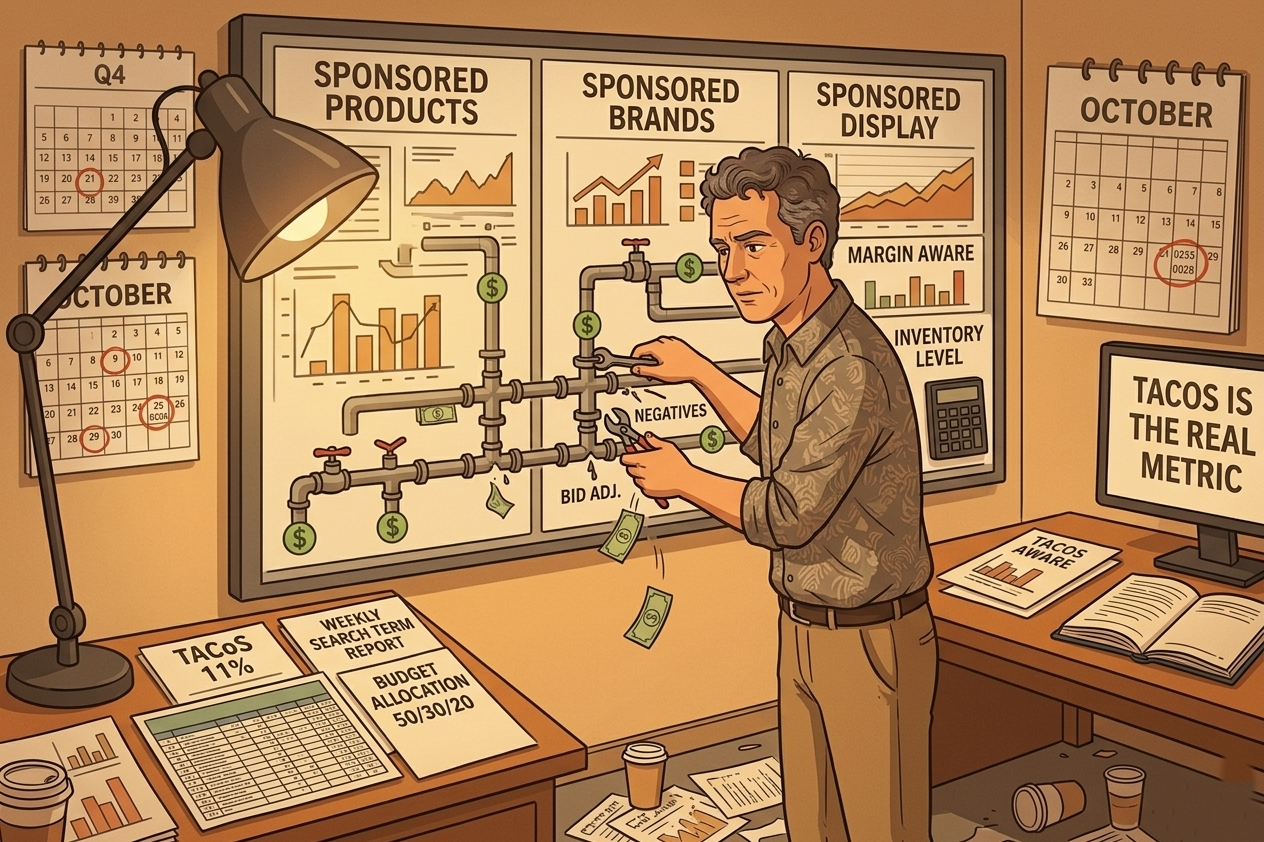
Advertising Optimization Framework: Here's where brands really bleed money. At this revenue level, you're probably spending $3,000-$5,000 monthly on Amazon PPC. If your ACoS is running 32% when it should be running 22%, that's about $1,500 monthly in wasted spend. Every single month.
The difference between okay advertising and great advertising comes down to campaign architecture, not random tactics. Proper structure means understanding which match types to use when, how to sculpt negative keywords systematically, which placements actually convert for your products, and how different campaign types work together.
What most brands don't realize is that advertising expertise isn't something you pick up from YouTube videos. It requires managing significant ad spend across different categories to understand the platform's nuances and when specific strategies actually work versus when they just sound good in theory.
Financial Tracking System: At $25K monthly, you need to know your numbers precisely. What's your actual landed cost per unit after shipping and duties? What are your true Amazon fees by product? What's your real profit per unit AFTER advertising? Which products are making money and which are bleeding cash?
Without this clarity, you're making decisions blind. Should you raise prices? Discontinue a product? Push certain SKUs harder? You can't know without accurate financial data.
The typical implementation takes 15-20 hours to set up properly, then about 5-8 hours monthly to maintain. Or you hire an e-commerce bookkeeper for $600-$1,000 monthly. Based on our experience, brands usually find $2,000-$4,000 monthly in hidden costs or missed opportunities within the first 60 days.
When DIY Stops Working
Let's have an honest conversation about the DIY ceiling. Some founders genuinely enjoy the operational details of running an Amazon business. If that's you, and you have the time, you can probably push to $30K-$35K monthly before the complexity overwhelms you.
But if you started this business to create income and freedom, not to become an Amazon operations expert, the DIY ceiling typically hits around $20K-$25K monthly. Here's how to know you've hit it: you're working 50-60 hours weekly but revenue won't budge, you're constantly putting out fires instead of planning growth, you know there are opportunities but don't have time to pursue them, or you're losing team members because everything depends on you.
When we start partnering with brands at this stage, the typical pattern is consistent. We spend 30-45 days building proper systems and documentation. By day 60, the founder's workload has dropped by 30 hours weekly while revenue increases 25-35%. That's not magic, it's just knowing which systems actually matter and how to implement them properly.
The $50K Milestone: Scaling With Capital and Expertise
Breaking past $30K monthly and pushing toward $50K introduces entirely different challenges. At this level, it's not about time or systems anymore. It's about capital and expertise.
Growing from low six figures to mid six figures monthly requires serious inventory investment. You need deeper relationships with suppliers who'll prioritize your orders. You need sophisticated advertising strategies that maintain profitability at higher spend levels. And you need financial systems that can handle complex decisions about pricing, product mix, and growth investment.
The Capital Challenge
Here's the math that stops many brands: at $50K monthly revenue with 30% profit margins, you're netting about $15,000 monthly. Sounds great, right? Except you need roughly $75,000-$100,000 in inventory to support that revenue level, assuming 90-day supply and reasonable turnover.
If your monthly profit is $15K, how do you fund $100K in inventory? Either you've been saving aggressively for months, you're taking on debt, or you're constantly running too lean and dealing with stockouts.
Most brands don't think about working capital strategically until it becomes a crisis. Then they make desperate decisions like cutting inventory to dangerous levels or turning down growth opportunities because they can't fund the inventory needed.
Professional financial planning at this stage means calculating cash conversion cycles to know exactly how long money stays tied up in inventory, structuring supplier terms that reduce upfront capital needs, using lines of credit strategically for seasonal inventory builds, and knowing precisely which products deliver the fastest cash conversion so you can prioritize them.
This isn't sexy work, but it's the difference between brands that scale smoothly and brands that constantly struggle with cash.
The Expertise Gap
The other bottleneck at this level? Amazon platform expertise. The difference between someone who "knows how to run PPC" and someone who really understands campaign architecture, bid optimization, and attribution modeling can easily translate to $30,000-$40,000 annually in wasted spend or missed opportunity based on industry benchmarks.
Same with inventory forecasting. With supplier negotiations. With listing optimization. With account health management. All of these areas have real expertise that dramatically impacts profitability.
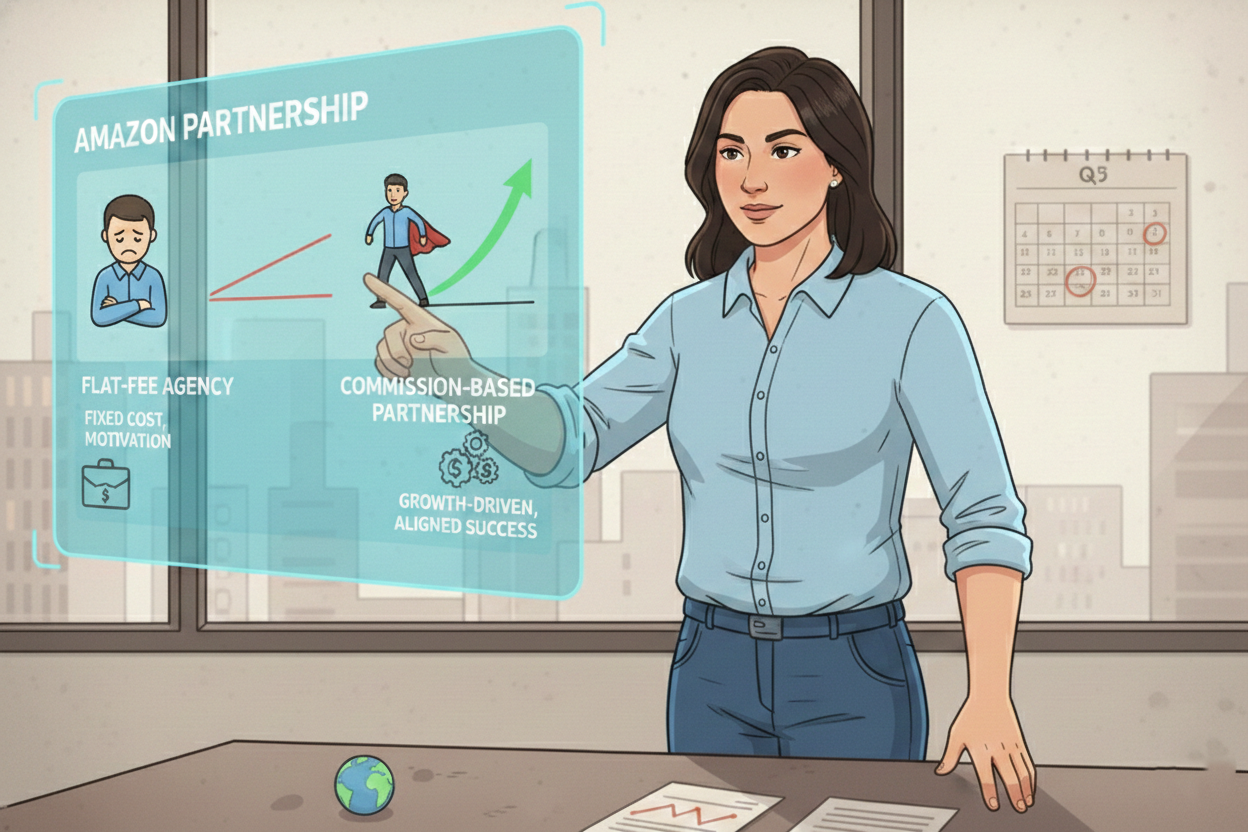
You have three options: spend 2-3 years developing this expertise yourself through expensive trial and error, hire full-time employees with this expertise for $80,000-$120,000 annually per role, or partner with an agency that already has this expertise across all areas.
The honest financial equation: professional partnership typically costs $4,000-$7,000 monthly depending on what you need. Compare that to hiring even one full-time expert, or compare it to staying stuck at $30K monthly for another 18 months while you figure things out yourself.
The Scaling Investment Framework
Let me give you the honest numbers you need to evaluate what scaling actually requires at each stage. These are based on industry standards and our direct experience working with growing Amazon brands.
$5K to $15K Monthly (Foundation Stage): You need team members to buy back your time, which costs roughly $2,000-$3,000 monthly. Time required to set up and manage: about 30-40 hours initially, then 10-15 hours weekly ongoing. Timeline: typically 60-90 days to see meaningful results. Expected outcome: 35-45 hours weekly bought back, revenue increase of 40-80% as you focus on growth activities.
$15K to $35K Monthly (Systems Stage): You need proper systems and either software or expertise, costing roughly $3,500-$5,500 monthly including team, software, and either your time or professional help. Time required: 40-60 hours to implement systems, then 15-20 hours weekly to manage. Timeline: 90-120 days to fully implement and optimize. Expected outcome: operations running 60% more efficiently, revenue increase of 50-100% as systems enable growth.
$35K to $60K+ Monthly (Scale Stage): You need capital for inventory, deep expertise for optimization, and sophisticated systems. Total investment typically runs $6,000-$10,000 monthly including everything. Time required: minimal if done right - maybe 20-25 hours weekly on strategic decisions. Timeline: 6-9 months to build this level of infrastructure properly. Expected outcome: sustainable 7-figure annual business with enterprise-level operations.
The compounding effect is where this gets interesting. Brands that invest properly at each stage typically see 60-90 day payback periods on their investments. Meaning the increased revenue and efficiency pays for the investment cost within 2-3 months, then it's all upside from there.
Common Scaling Mistakes (And How to Avoid Them)
After working with Amazon brands and studying successful scaling patterns, certain mistakes emerge repeatedly. The errors are predictable, but so are the solutions.
Mistake 1: Hiring before documenting. You bring on team members but don't have clear processes, so they constantly interrupt you with questions. Solution: spend 20-30 hours documenting your key processes before you hire anyone.
Mistake 2: Investing in software before systems. You buy fancy tools hoping they'll solve your problems, but without proper processes the tools just create expensive chaos. Solution: build manual systems first, then automate what's working.
Mistake 3: Cutting prices to increase sales. Revenue grows but profit tanks, and suddenly you can't afford the inventory needed to maintain volume. Solution: focus on efficiency and margin improvement before volume, then scale profitably.
Mistake 4: Adding products before optimizing existing ones. You launch new SKUs hoping to break through plateaus, but you haven't fixed the operational issues holding back your current products. Solution: maximize what you have before expanding your catalog.
Mistake 5: Trying to scale entirely on reinvested profit. You refuse outside capital or credit, which means inventory constraints constantly limit growth. Solution: understand that strategic debt or outside capital can deliver 300-500% ROI if deployed properly.
The real pattern? Most scaling mistakes come from trying to skip steps or avoid necessary investments. But growing from low six figures to mid or high six figures monthly requires real infrastructure. The brands that commit to building it properly tend to succeed. The brands that try to hack their way around it typically stay stuck.
Calculating Your Scaling ROI
Here's the framework we use when brands are evaluating whether to invest in proper scaling infrastructure:
Current State: You're doing $18,000 monthly revenue, working 55 hours weekly, netting roughly 25% profit after costs, which means $4,500 monthly profit or $54,000 annually. Your effective hourly "wage" is about $18.75, which probably feels frustrating given how hard you're working.
Scaled State (12 months later): You're doing $45,000 monthly revenue, working 25 hours weekly on strategic activities, netting roughly 20% profit after team and system costs, which means $9,000 monthly profit or $108,000 annually. Your effective hourly "wage" is now $83, and you've bought back 30 hours weekly to either scale further or reclaim your life.
The investment to get there: roughly $4,500-$6,000 monthly in team, systems, and professional partnership for months 1-6, then about $3,500-$4,500 monthly ongoing. Total first-year investment: approximately $54,000-$63,000.
Net benefit: additional $54,000 in profit plus 1,560 hours of your life back. If you value your reclaimed time at just $40 per hour, that's $62,400 in time value. Total first-year return: roughly $116,400 for a $58,500 investment. That's about 199% ROI.
And year two compounds even harder because the systems are built, your team is trained, and you're just optimizing rather than building from scratch.
What Partnership Actually Looks Like
The partnership approach we've developed isn't about taking over your business. It's about building the infrastructure that lets your business grow beyond what you can handle alone.
Here's how it typically works when we start partnering with brands ready to scale: Month 1 is all foundation work - we audit current operations, document what's working and what isn't, identify the exact bottlenecks holding you back, and begin hiring or restructuring team members. Revenue usually stays flat because we're fixing infrastructure, not pushing growth yet.
Month 2-3 is systems implementation. We build proper inventory forecasting, restructure advertising campaigns for efficiency, implement financial tracking that shows real profitability, and document all processes so they're repeatable. Revenue typically increases 20-35% as systems start working properly.
Month 4-6 is optimization and scale. Now we're focusing on growth activities, expanding what's working, testing new opportunities, and systematically improving efficiency. Revenue usually jumps another 30-50% as everything compounds together.
By month 7, brands are typically generating 70-100% more revenue, operating 50-60% more efficiently, and the founder's working 25-35 fewer hours weekly. That's not because we're magic. It's because we've built these systems multiple times and know exactly where the leverage points are.
The Real Question: Are You Ready to Scale?
Scaling an Amazon business isn't about wanting to grow. It's about being ready to change how you operate. The strategies that got you to $8K monthly won't get you to $40K. The operations that work at $15K monthly will actively hold you back at $35K.
The real question isn't whether you can scale. It's whether you're willing to invest in the infrastructure, team, and systems required to make it happen.
If you're doing between $5,000 and $30,000 monthly right now and you're feeling stuck, that's completely normal. You've outgrown one level but haven't built the systems needed for the next. The good news? The path forward is clear. The systems are proven. The ROI is measurable.
But it requires commitment. Not just hoping things will improve if you work harder, but actually changing how your business operates at a fundamental level. Building the team, implementing the systems, and making the investments that enable sustainable growth.
Many Amazon sellers never do this. They stay stuck at $10K or $20K monthly for years, working themselves to exhaustion, wondering why they can't break through. Don't be one of them.
Ready to break through your revenue ceiling? Schedule a scaling assessment to discover exactly what's holding your Amazon business back and map out the specific systems you need for your next growth stage.
Recent Posts