Amazon Negative Review Management: Protection Strategies That Actually Work
Most brands treat negative reviews like whack-a-mole. A one-star pops up, panic sets in, someone fires off an emotional response (or worse, nothing at all), and everyone moves on until the next one hits. Meanwhile, conversion rates quietly erode, ad efficiency tanks, and that 4.2-star rating creeps toward 3.8.
We've watched this pattern unfold across dozens of brands, and the frustrating part is this: the reviews themselves usually aren't the real problem. They're symptoms. The brands that excel at Amazon negative review management aren't the ones obsessing over every critical comment. They're the ones building systematic protection strategies that address root causes while handling the inevitable complaints with precision.
What separates brands with resilient reputations from those constantly firefighting? It comes down to three things: knowing what you can actually control, building prevention into your operations, and responding strategically when problems surface. Most advice on this topic focuses entirely on the response piece. We're going to dig into all three.
What Amazon Actually Lets You Do About Negative Product Reviews
Before we talk strategy, let's be direct about what's possible within Amazon's current policies. You cannot delete negative reviews yourself. You cannot offer incentives to change or remove them. You cannot contact customers outside Amazon's messaging system to discuss reviews. Violation of these rules leads to account suspension, and Amazon's enforcement has tightened considerably.
What you can do is report reviews that violate Amazon's community guidelines. Reviews containing obscene language, promoting competitors, or coming from conflicts of interest (like a competitor or someone with a financial stake) are removable. The process involves either using the "Report abuse" button or emailing community-help@amazon.com with your ASIN, the specific review, and your explanation of the violation.
The success rate on these reports varies. We've seen brands get legitimate violations removed within days. We've also seen clear policy violations sit untouched for months. Persistence matters, and documentation helps, but there's no guarantee.
In some cases, you can also respond to customer reviews inside Amazon Seller Central. This is where many brands mess up. Either they ignore reviews entirely, respond defensively, or copy-paste the same generic "We're sorry you had this experience" message that signals they don't actually care. More on effective responses shortly.
The Hidden Math: How Negative Reviews Actually Cost You Money
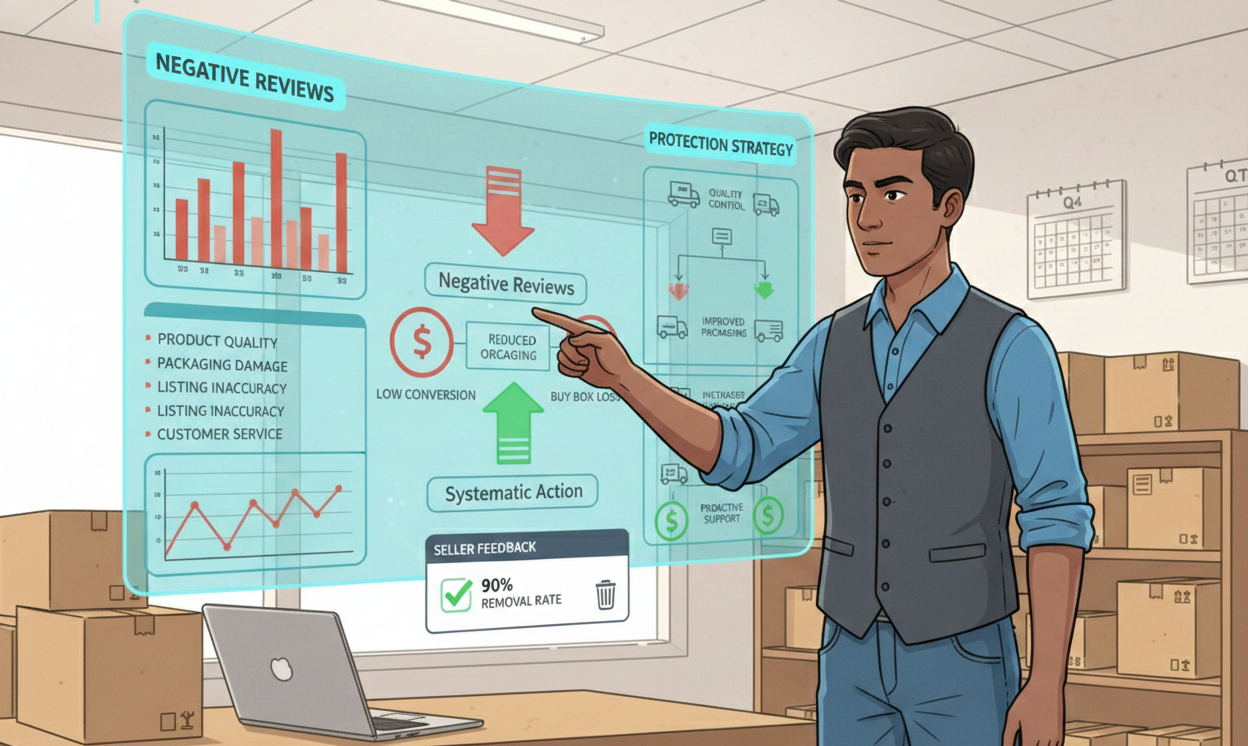
A single negative review doesn't just subtract one point from your average. The damage compounds in ways most brands underestimate.
Consider the conversion impact first. What we've seen across our client base consistently shows that products with ratings below 4.0 stars see conversion rate drops of 25-40% compared to similar products above that threshold. For a product generating $50,000 monthly in revenue, even a 15% conversion drop means $7,500 in lost sales. And that assumes your traffic stays constant, which it won't.
Lower conversion rates trigger Amazon's algorithm to reduce your organic visibility. You start appearing lower in search results. Your ads become less efficient because you're paying the same cost-per-click but converting fewer buyers. Competitors with better ratings capture the customers you're losing.
Then there's the Buy Box calculation. Amazon factors seller performance metrics into Buy Box eligibility, and review patterns can signal underlying fulfillment or quality issues that hurt your position. Lose the Buy Box and you're effectively invisible on your own listing and can no longer advertise.
The compounding effect means a handful of negative reviews, left unaddressed, can create a downward spiral where each problem makes the next one worse. Brands often don't realize how much ground they've lost until recovery requires significant investment.
Prevention: The Review Strategy Most Brands Skip
Addressing negative reviews after they appear is necessary. Preventing them from happening is more valuable. Yet most brands spend 90% of their review management energy on response and 10% on prevention. That ratio should be reversed.
Prevention starts with understanding why negative reviews happen in the first place. For most brands, the causes cluster into a few categories: product quality issues, packaging and shipping damage, listing inaccuracies that create expectation mismatches, and customer service failures.
Quality issues require systematic root cause analysis. When we partner with brands on this, we look at patterns in negative feedback. Are the same components failing? Is there a manufacturing batch correlation? Sometimes the fix is a supplier conversation. Sometimes it's a product redesign. But you can't fix what you haven't diagnosed.
Shipping damage often traces back to packaging that works fine for warehouse storage but fails the rigors of last-mile delivery. This is especially common for brands selling items that are fragile, oddly shaped, or temperature-sensitive. Upgrading packaging adds cost, but it's usually cheaper than the returns, replacements, and negative reviews that result from damaged deliveries.
Listing inaccuracies are surprisingly common and completely preventable. If your product images show accessories that aren't included, if your dimensions are wrong, if your description promises features the product doesn't have, you're manufacturing disappointment. Audit your listings against the actual customer experience. Read your negative reviews and look for patterns around unmet expectations.
Customer service failures happen when buyers have problems and don't get resolution. Slow response times, unhelpful answers, and difficult return processes all generate negative reviews that could have been positive experiences. Many frustrated customers would give you a second chance if you made it easy.
Strategic Response: When and How to Engage
Not every negative review deserves the same response. Part of effective Amazon negative review management is triaging based on impact and recoverability.
High-priority reviews warrant immediate, personalized attention. These include reviews that describe specific, fixable problems; reviews from customers who seem reasonable and open to resolution; reviews on your bestselling products where rating protection matters most; and reviews that might influence other potential buyers significantly.
Lower-priority reviews include rants without specific complaints, reviews clearly from unreasonable customers, and reviews on products you're phasing out anyway.
Since Amazon removed the option for public responses to product reviews, your options for engaging are more limited but still meaningful. The first and most effective approach is reaching out through Amazon's buyer-seller messaging system. Amazon sends an uneditable email on your behalf, which opens a dialogue where you can understand the issue and work toward resolution. The second option is issuing a courtesy refund, which can be appropriate when the problem is clear-cut and the customer's frustration is justified.
When you do make contact, effective outreach acknowledges the specific problem (showing you actually read the complaint), takes responsibility without making excuses, offers a concrete next step, and demonstrates genuine interest in making it right. Keep it brief and human — no corporate speak, no defensiveness, no implications that the customer is wrong.
Then actually follow through and solve their problem. The goal isn't to make the negative review disappear. It's to turn a frustrated customer into someone who knows you handle problems well.
Negative Seller Feedback
Negative seller feedback operates differently from product reviews, and brands using Fulfillment by Amazon (FBA) have more leverage here than most realize. Because Amazon handles the shipping and delivery for FBA orders, they'll typically take ownership of negative feedback related to fulfillment issues — late deliveries, damaged packaging, and similar complaints that fall under their operational responsibility.
Where it gets more nuanced is the crossover between product reviews and seller feedback. Customers frequently leave product complaints in the seller feedback section, which isn't where they belong. Identifying and flagging these misplaced reviews is one of the most consistently impactful things we do for our clients. Sometimes a straightforward removal request through Seller Central resolves it immediately. Other cases require submitting a support case with documentation explaining why the feedback qualifies for removal.
This isn't a guaranteed process, but over seven years of managing seller feedback across our client base, we've maintained a removal rate above 90% for feedback that's misplaced or falls under Amazon's fulfillment responsibility. That kind of consistent housekeeping protects your seller metrics in ways that compound over time.
Taking the Next Step
Your current review situation tells a story. The question is whether you're reading it accurately and responding strategically. We offer a review audit that examines your current review patterns, identifies the operational factors driving negative feedback, and maps out what systematic improvement would look like for your specific products.
This isn't about promising to delete your bad reviews. It's about building a reputation protection strategy that compounds over time, so you stop playing whack-a-mole and start building the kind of review profile that drives sustainable growth.
If reviews have become a persistent challenge, or if you're simply tired of the reactive approach, reach out to discuss what partnership could look like.
Recent Posts