Amazon PPC Scaling: Why ROI Matters More Than Higher Spend

Here's some full transparency about Amazon PPC scaling: most brands think growth means spending more on ads. They push budgets from $3,000 to $8,000 monthly, watch sales increase temporarily, then realize their profit margins have collapsed. The revenue went up, but the money disappeared.
I've seen this pattern repeatedly. Brands increase ad spend by 150%, see revenue climb 40%, and celebrate the "growth." Three months later they're wondering why there's no cash in the bank. The problem? They scaled spending without scaling profitability.
But here's what our team has learned from managing substantial advertising campaigns: successful PPC scaling isn't about spending more money. It requires a partnership approach where we work together to build systematic optimization that increases revenue while maintaining or improving your return on investment.
In this guide, I'll share the proven strategies we use to help growing brands scale Amazon PPC without burning cash. You'll learn why ACoS or ROAS alone is a dangerous metric, understand which campaigns actually deserve more budget, and discover exactly when throwing more money at advertising stops working.
Most importantly, we'll have an honest conversation about what profitable scaling really costs, the expertise required to do it properly, and how to calculate whether aggressive advertising growth makes financial sense for your specific margins and category.
Why Most PPC Scaling Fails
The biggest mistake? Thinking that more spending automatically means more profit. Brands see their best-performing campaign running at 22% ACoS and assume doubling the budget will just double the sales at the same efficiency. That's not how Amazon's auction system works.
When you dramatically increase budgets, several things happen that brands don't anticipate. Your bids push higher to compete for more impressions, which increases your average cost per click. You start showing up for broader, less-qualified searches that convert poorly. Your ads appear in lower-quality placements where click-through rates suffer. And your overall ACoS climbs even though you're spending more.
Research shows that CPCs have risen 15-30% year-over-year across many categories as more brands compete for the same limited impression space. Throwing more money at campaigns without strategic targeting just accelerates this cost inflation for your account.
The result? Brands spend $5,000 more monthly on advertising, generate $8,000 in additional revenue, but after product costs and fulfillment, they've actually reduced their monthly profit by $1,500. That's not scaling. That's just buying expensive revenue that doesn't build your business.
Real scaling means systematically finding the profitable growth opportunities within your advertising structure, investing strategically in campaigns and keywords that deliver genuine return, and having the discipline to cut spend from areas that are burning cash regardless of how much revenue they generate.
Understanding True Advertising ROI (Not Just ACoS)
Most brands obsess over ACoS - Advertising Cost of Sale. If you spend $30 on ads and generate $100 in attributed sales, that's 30% ACoS. Seems straightforward, right? But ACoS alone is a terrible metric for measuring profitability.
Here's why: a 30% ACoS might be fantastic for a product with 50% margins, delivering 20% net profit even after advertising. That same 30% ACoS destroys profitability on a product with 35% margins, leaving you with just 5% net after ad costs. The ACoS looks identical, but one scenario builds your business while the other slowly bleeds it dry.
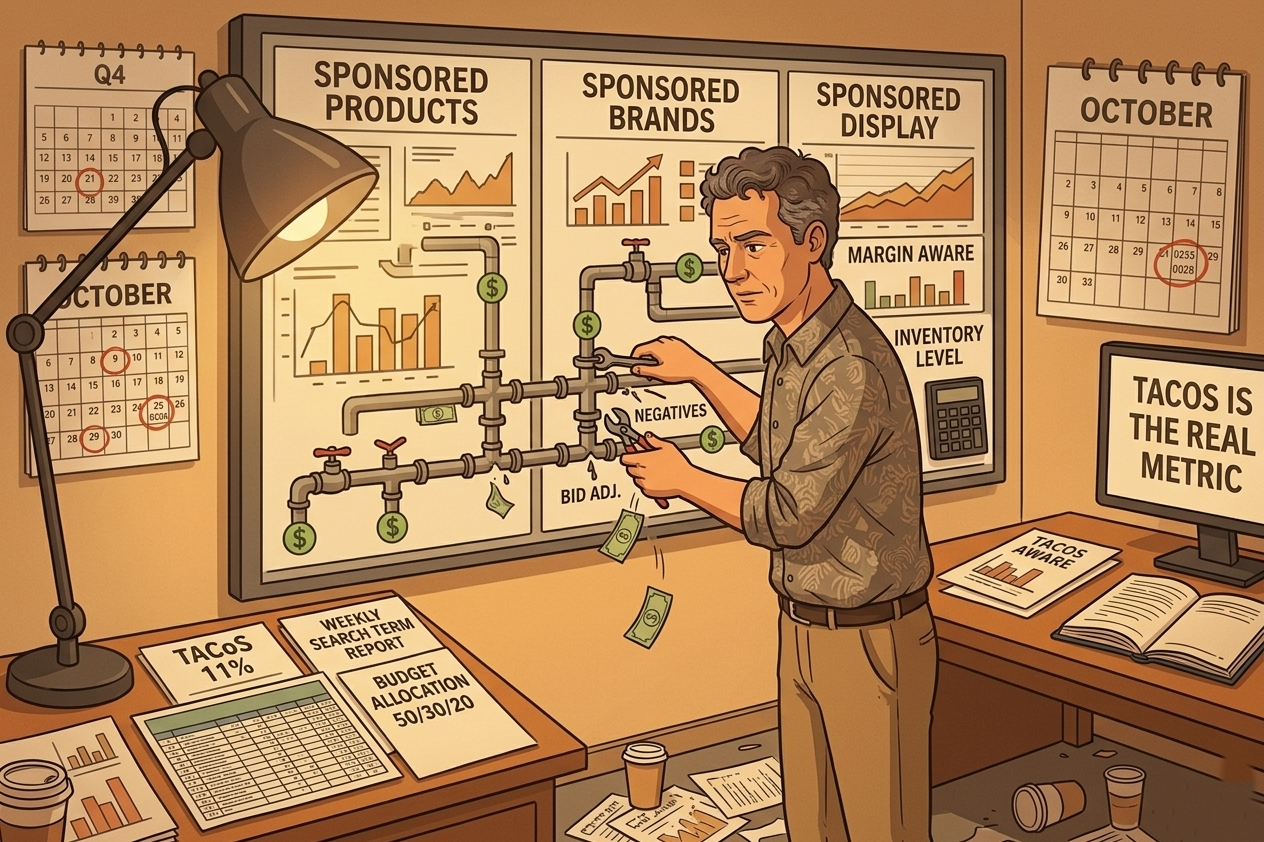
Smart brands track TACoS (Total Advertising Cost of Sales) instead. TACoS measures ad spend against total revenue including organic sales, revealing whether your advertising is actually growing the business or just cannibalizing organic traffic.
Based on industry data, brands doing low six figures annually typically see healthy performance around 20-25% ACoS, and TACoS below 12-15% on their core products. But these benchmarks vary significantly by category, competition level, and margin structure.
What most brands don't realize is that successful advertising should improve your organic ranking over time, which reduces your TACoS as organic sales grow. If you're scaling ad spend but your organic sales aren't increasing proportionally, something is fundamentally wrong with the strategy.
The real metric that matters? Profit per unit after advertising costs. That's what pays your bills. You can have beautiful ACoS numbers and still go bankrupt if you're not tracking actual profitability per sale.
The Campaign Architecture That Enables Profitable Scaling
Before you can scale anything, you need proper campaign structure. This is where most brands completely miss the opportunity. They're running 2-3 campaigns, mixing branded and generic keywords together, throwing budget at auto campaigns, then wondering why performance is inconsistent.Before you can scale anything, you need proper campaign structure. This is where most brands completely miss the opportunity. They're running 2-3 campaigns, mixing branded and generic keywords together, throwing budget at auto campaigns, then wondering why performance is inconsistent.
Professional campaign architecture means systematic segmentation that gives you granular control over where money goes and how performance gets tracked. Let's break down what this actually looks like.
Branded campaigns should be completely separate with their own budget. These keywords convert at 30-40% typically (industry standards) and run at 8-15% TACoS because you're capturing people already searching for your brand. You want these campaigns maxed out on budget because they're defending your brand territory from competitors. Mixing them with generic keywords dilutes your data and prevents proper optimization.
Competitor campaigns target other brand names in your category. These typically run higher ACoS, maybe 35-50%, because you're stealing traffic from established brands. But if your product is genuinely better or priced more competitively, these campaigns can deliver a strong return. Keep them separate so you can evaluate performance clearly and make informed budget decisions.
Generic keyword campaigns should be segmented by match type - exact match in one campaign, phrase match in another. Exact match gives you precision and typically delivers your best performance on proven keywords. Phrase match helps you scale reach while maintaining reasonable control. Broad match? That's for discovery only, not for significant budget allocation unless you really know what you're doing.
Product targeting campaigns focus on specific products or categories. These let you show up on competitor listings or related product pages. Performance varies dramatically based on targeting choices, so you need them isolated for proper measurement.
Auto campaigns are discovery tools, not growth engines. They help you find new keyword opportunities by letting Amazon's algorithm show your ads broadly. But once you've extracted the valuable keywords into manual campaigns, auto campaigns should receive minimal budget - just enough to keep discovering without burning cash on irrelevant traffic.
When we start working with brands and rebuild their campaign architecture properly, the typical pattern is consistent: within 30-45 days, overall ACoS drops while revenue stays flat or increases slightly. That's not magic, it's just having proper structure that lets you optimize systematically instead of guessing.
Smart Budget Scaling: Where to Invest vs. Where to Cut
Once you have proper structure, scaling becomes a systematic process of identifying what's working and strategically investing in proven performance. The mistake most brands make? They scale everything proportionally, giving more budget to both their winners and losers.
The data-driven approach focuses on campaign and keyword profitability over sustained periods. You're looking for campaigns that maintain stable, profitable metrics across at least 30-60 days. Anything shorter might just be statistical noise or seasonal fluctuation.
Industry best practice suggests that roughly 80% of your ad spend should go to the top 20% of your campaigns based on profitability, not revenue. This means you might have a campaign generating significant sales but running at 45% ACoS that gets budget cuts, while a smaller campaign at 18% ACoS gets aggressive investment. It feels counterintuitive, but you're optimizing for profit, not vanity metrics.
When scaling budget on proven campaigns, the smart approach is incremental increases with close monitoring. Bump a campaign budget by 20-30%, watch performance for 7-10 days, evaluate whether efficiency held or declined, then decide on the next move. Doubling budgets overnight usually destroys efficiency because Amazon's algorithm needs time to adjust and optimize at higher spend levels.
The flip side of scaling up is cutting down. Brands hate doing this, but it's essential. If a campaign consistently runs above your profitability threshold, you need to make hard choices: reduce bids to improve efficiency even if volume drops, cut budgets by 50% and reallocate to better performers, or pause it entirely if there's no path to profitability.
What most brands don't realize is that cutting unprofitable spend often increases total profit even though revenue might dip slightly. Spending $4,000 monthly on ads that generate $10,000 in sales at 40% ACoS leaves you with $6,000 gross before product costs. If your product costs are 50%, you're netting $1,000. But spending $3,000 on optimized campaigns that generate $9,000 at 25% ACoS leaves you netting $2,250. Lower revenue, higher profit.
This is where professional expertise becomes critical. Knowing which campaigns to scale, which to cut, and how to rebalance your budget allocation requires experience across multiple accounts and categories. The typical brand owner is making these decisions based on one account's data, which means expensive trial and error.
The Hidden Costs of DIY PPC Scaling
Let's have an honest conversation about what it actually costs to scale Amazon PPC properly. Not just the ad spend itself, but the real investment in expertise, time, and optimization work.
If you're doing this yourself, scaling from $3,000 to $8,000 monthly in ad spend requires roughly 20-30 hours weekly of focused work to do it properly. That's campaign monitoring, keyword & listing optimizations, bid adjustments, negative keyword management, performance analysis, and strategic planning. At even a modest value of $50 per hour for your time, that's $4,000-$6,000 monthly in opportunity cost.
And that assumes you actually know what you're doing. The learning curve for sophisticated PPC management typically takes 12-18 months of expensive trial and error. One brand I know spent six months "learning" PPC optimization and burned through roughly $25,000 in wasted ad spend compared to what proper management would have achieved. That's on top of the revenue they didn't capture because their campaigns underperformed.
The alternative is hiring in-house expertise. A competent PPC manager with real Amazon experience typically costs $75,000-$95,000 annually, plus benefits and overhead bringing you to roughly $100,000-$120,000 total. If you're spending less than $8,000-$10,000 monthly on ads, the math doesn't justify that investment.
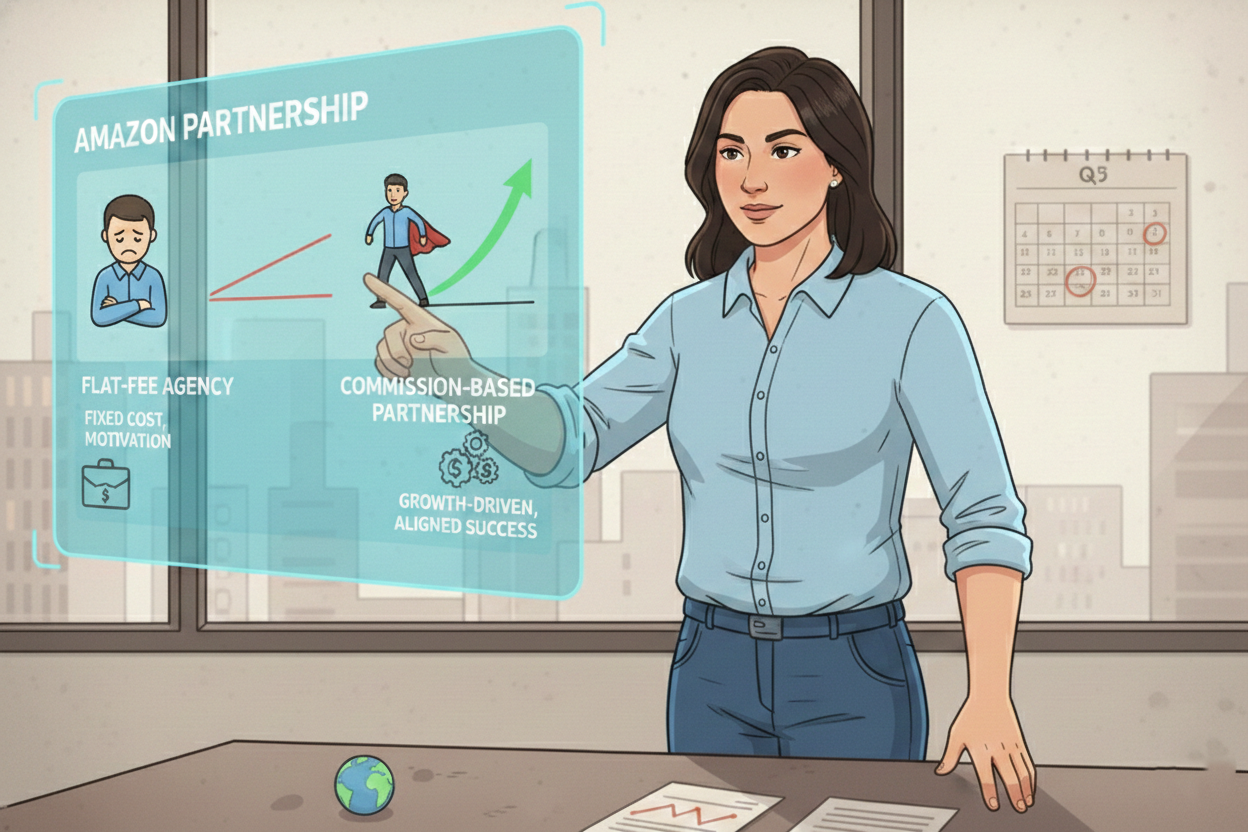
Or you partner with an agency that already has deep platform expertise across multiple accounts and categories. Compare that to hiring someone or doing it yourself inefficiently.
But here's what many brands miss when evaluating this: the cost of bad PPC management isn't the management fee. It's the wasted ad spend from poor optimization. If professional management improves your ACoS from 32% to 24% on $6,000 monthly spend, that's $480 monthly in direct savings, roughly $5,760 annually. Add the revenue growth from better campaign structure and optimization, and the ROI becomes obvious.
The real question isn't whether you can afford professional PPC management. It's whether you can afford not to have it when you're spending thousands monthly on advertising.
Advanced Strategies for Sustained Profitable Growth
Once your foundation is solid - proper campaign structure, systematic optimization, disciplined budget allocation - you can implement advanced strategies that multiply effectiveness without multiplying spend.
Dayparting and scheduling means adjusting bids based on when your ads perform best. If your conversion rates are 30% higher Tuesday through Thursday, you might bid more aggressively those days and pull back on weekends when efficiency drops. This requires data analysis and often automation, but it can improve overall ROAS by 15-20% based on industry performance data.
Placement optimization focuses your spend on the placements that actually convert. Top of search typically delivers your best performance but costs more. Product pages can be profitable if targeted properly. Rest of search is often where budgets go to die. By analyzing placement-level data and adjusting bid modifiers, you can shift spend toward high-performing placements systematically.
Sponsored Brands and Sponsored Display campaigns add reach beyond just Sponsored Products. Brands video ads particularly drive higher engagement and can justify premium placement costs. But these ad types require different optimization approaches and creative development that most brands don't have in-house.
Negative keyword mastery is arguably the most underutilized optimization lever. Most brands add negatives reactively when they notice wasted spend. Professional management builds systematic negative keyword lists based on search term reports, category-specific irrelevant terms, and predictive analysis. This prevents waste before it happens.
The partnership approach we've developed layers these advanced strategies on top of solid fundamentals. We don't jump straight to sophisticated tactics because they don't work without proper foundation. But once the foundation is built, these strategies multiply effectiveness significantly.
Calculating Your PPC Scaling ROI
Here's the framework we use when brands are evaluating whether to invest in aggressive PPC scaling:
Current State: You're spending $4,000 monthly on Amazon PPC, generating roughly $20,000 in attributed sales at 20% ACoS, with total revenue including organic at $35,000 monthly. Your TACoS is 11.4%, margins are 35%, and you're netting about $8,250 monthly profit after all costs.
Scaled State (6 months later): You're spending $8,000 monthly on systematically optimized PPC, generating roughly $44,000 in attributed sales at 18% ACoS (improved efficiency), with total revenue including organic at $72,000 monthly because advertising improved rankings. Your TACoS is now 11.1%, margins held at 35%, and you're netting about $18,200 monthly profit.
The investment to get there: you scaled ad spend by $4,000 monthly, but that's a direct revenue generator, not a cost.
Net benefit: additional $9,950 monthly profit, which compounds to roughly $119,400 annually at the scaled level.
And the alternative? Trying to do this yourself means 25 hours weekly managing campaigns, roughly $5,000-$6,000 monthly in opportunity cost, probably 12-18 months to achieve similar results because of the learning curve, and likely $10,000-$20,000 in wasted ad spend during that learning period.
When to Scale vs. When to Optimize
Not every brand should be aggressively scaling PPC spend. Sometimes the smarter move is optimization and margin improvement before adding volume. Here's how to know which phase you're in.
Optimize first if: Your ACoS is above 30% on core products, your TACoS exceeds 15-18%, you're running fewer than 8-10 properly structured campaigns, you haven't done systematic negative keyword work in 90+ days, or your product listings haven't been optimized in the past 6 months.
Throwing more money at underperforming campaigns just accelerates cash burn. Get efficient first, then scale what's working.
Scale aggressively if: Your core campaigns consistently run 15-20% ACoS, your TACoS is below 12%, you have inventory capital to support increased sales, and your listings convert at 12%+ because they're properly optimized.
When the foundation is solid, scaling becomes a systematic process of finding the profitable growth ceiling for each campaign and keyword, then pushing budget until efficiency starts declining.
The hybrid approach works for most brands: maintain 70% of spend on proven performers, allocate 20% to systematic optimization and testing, and reserve 10% for experimental campaigns and new opportunities. This balances stability with growth without risking everything on unproven strategies.
What most brands don't realize is that advertising goes through natural cycles. Some quarters you're in scaling mode, pushing growth. Other quarters you're in optimization mode, improving efficiency. Fighting these cycles by forcing continuous scaling usually destroys profitability.
Professional management recognizes these patterns and adjusts strategy accordingly. We're not just blindly scaling spend, we're reading performance data and making strategic decisions about when to push growth versus when to improve efficiency.
The Real Path to Sustainable PPC Growth
Amazon PPC scaling isn't about spending more money. It's about building systematic infrastructure that finds profitable growth opportunities, investing strategically in what works, and having the discipline to cut what doesn't.
The brands that succeed long-term are the ones that focus on ROI rather than vanity metrics, build proper campaign architecture before scaling aggressively, and recognize when professional expertise delivers better returns than DIY trial and error.
If you're spending $3,000-$10,000 monthly on Amazon PPC right now and feeling like you're not getting the returns you should, that's completely normal. Most brands are flying blind, making optimization decisions based on incomplete data or misunderstood metrics.
The good news? The path forward is clear. Proper campaign structure, systematic optimization, disciplined budget allocation, and either deep expertise or professional partnership. These aren't secrets, they're just specialized skills that take years to develop through managing significant ad spend across categories.
But it requires commitment. Not just hoping that spending more will somehow improve results, but actually changing how you approach advertising at a fundamental level. Building the systems, implementing the optimizations, and making the investments that enable sustainable profitable growth.
Many Amazon sellers never do this. They keep throwing money at ads, watching ACoS climb, wondering why profit isn't growing with revenue. Don't be one of them.
Ready to scale your Amazon PPC profitably? Schedule a PPC audit to discover exactly where your advertising dollars are going and map out a data-driven strategy for ROI-focused growth.
Recent Posts