Amazon Advertising Management: What You’re Actually Paying For
If you're spending $5,000 or more per month on Amazon ads and can't clearly explain where that money goes, you're not alone. We talk to brand owners in that situation constantly. They log into their advertising console, see a wall of campaigns, and have no real idea which ones are carrying the weight and which ones are quietly burning cash.
The uncomfortable part isn't the spend itself. It's the gap between what you're paying and what you can actually see happening. Most brands we work with have run their own campaigns at some point, or they've handed them to an agency that sent monthly reports full of impressive-looking charts but couldn't answer basic questions about search term performance or how budget was split across ad types. That experience leaves a mark.
This article isn't a PPC 101 explainer. If you're already spending at this level, you understand Sponsored Products, Sponsored Brands, and Sponsored Display at a conceptual level. What we want to walk through is what professional Amazon advertising management actually involves on a daily and weekly basis, so you can decide whether the investment makes sense for your business.
The Operational Reality Behind Ad Management
Amazon PPC at scale is not "set up campaigns and check in monthly." The brands getting strong results from their ad spend are making adjustments multiple times per week.
Here's what that actually looks like in practice. Every week, someone needs to pull the search term report and comb through it for irrelevant queries eating budget. We've seen accounts where 30% or more of monthly spend goes to search terms that generate clicks but never convert. On a $10,000 monthly budget, that's $3,000 disappearing into searches that were never going to result in a sale.
Negative keyword management alone is a recurring job, not something you do once during campaign setup. New irrelevant terms surface constantly as Amazon's algorithm tests your ads against broader queries. Miss a week or two of search term reviews and those wasted clicks compound fast.
Beyond negatives, there's bid management across potentially hundreds of keyword and product targets. Bids that made sense 2 weeks ago may be too aggressive or too conservative today based on competitor behavior, seasonal shifts, or inventory changes. With average CPCs now sitting around $1.00 to $1.50 across Sponsored Products, even small bid inefficiencies add up when you're running dozens of campaigns.
Budget Allocation Across Ad Types
One of the decisions that separates effective Amazon ad management from basic campaign operation is how the budget gets distributed across Sponsored Products, Sponsored Brands, and Sponsored Display. Each ad type does a different job at a different point in how shoppers find and buy from you, and the right mix depends on your category, competition, and growth stage.
Sponsored Products typically drive the most direct sales and consume the largest share of budget for most brands. But leaning too heavily on Sponsored Products alone means you're competing purely on the product level without building any brand recognition. Sponsored Brands campaigns put your brand name and logo in front of shoppers during the research phase. Sponsored Display reaches customers who viewed your products or similar products but didn't purchase.
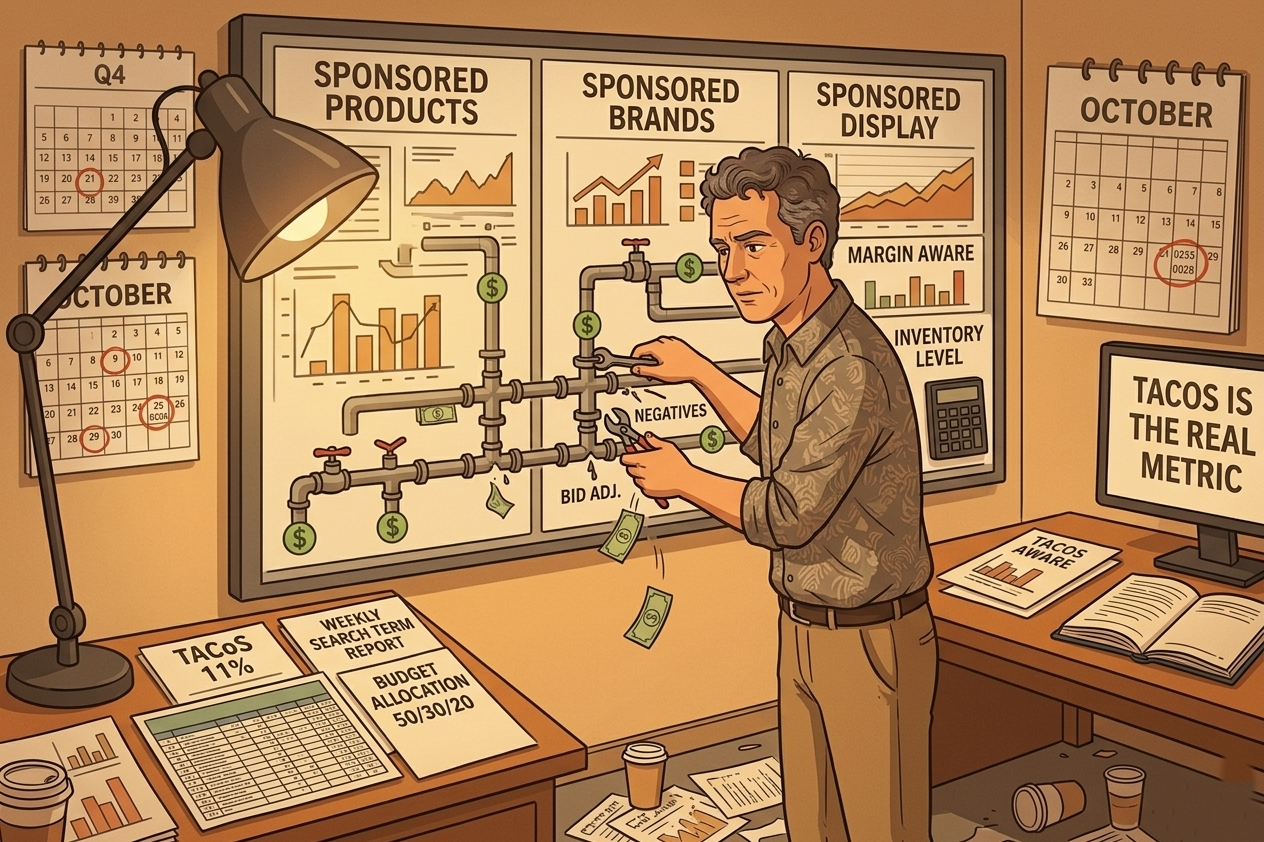
The allocation question isn't static. During a product launch, you might run Sponsored Products at 70% of budget to build sales velocity and organic rank. 3 months later, that same product might perform better with a 50/30/20 split as you shift toward profitability and brand defense. We adjust these ratios regularly based on what the data shows, not based on a formula we decided on during onboarding.
Getting this wrong is expensive. We've seen brands dump their entire budget into Sponsored Products, achieve a 35% ACoS, and assume that's just what Amazon advertising costs. After restructuring with a proper mix across ad types, that same spend often performs significantly better because each campaign type is doing the job it was designed for.
There's also a defensive component that many brands miss. If you're not running Sponsored Brands on your own brand name, competitors probably are. Someone searching specifically for your brand can see a competitor's ad at the top of the results before they ever find you. Brand defense campaigns typically run at very low ACoS because the traffic is already looking for you, but you still need to allocate a budget for them. Ignoring brand defense to put more into prospecting is a common mistake that quietly bleeds customers to competitors.
And budget allocation doesn't happen in isolation from inventory. Running aggressive ads on a product with 3 weeks of stock left is a fast way to stock out during your highest-velocity period. On the flip side, sitting on slow-moving inventory that's accumulating storage fees while those products get no ad support means you're paying to warehouse products you're not trying to sell. We adjust ad spend alongside inventory levels weekly, scaling bids down as stock gets thin and pushing harder on products where margins and supply both support it.
Campaign Structure That Actually Scales
Most campaigns we inherit have a structural problem before we even look at bids or keywords. Too many keywords stuffed into too few campaigns, no segmentation between match types or product groups. A broad match keyword generating impressions at $0.40 CPC gets averaged together with an exact match term converting at $1.80 CPC, and your reporting tells you nothing useful.
Proper campaign architecture means separating by match type so you can control bids independently, and grouping products by margin profile so your target ACoS reflects what each product can actually afford to spend on advertising. A product with 40% margins can sustain a very different ACoS target than one running at 22%.
This structure isn't complicated conceptually, but building it out across a catalog of 50 or 200 SKUs takes real time. And maintaining it requires ongoing attention as you add new products, pause underperformers, and respond to competitive shifts. The average ACoS across Amazon sits around 30% right now. Top performers in well-structured accounts operate in the 15-25% range. The difference is almost entirely structural and operational, not strategic magic.
The Metrics That Actually Tell You Something
Most brand owners track ACoS (Advertising Cost of Sale) as their primary advertising metric. It's useful, but it only tells you part of the story. ACoS measures how much you're spending on ads relative to the revenue those ads directly generate. It says nothing about what those ad-driven sales are doing for your organic ranking or your overall business profitability.
This is where TACoS (Total Advertising Cost of Sale) becomes the metric that matters more as you scale. TACoS measures your ad spend against your total revenue, including organic sales. A brand spending $5,000 per month on ads with a 28% ACoS might look mediocre on paper. But if that same brand's TACoS is 11% because the advertising is driving enough sales velocity to boost organic rankings, those ad dollars are working harder than the ACoS number suggests.
We've seen this pattern consistently across accounts we manage. Early in a product's lifecycle, ACoS runs high because you're buying visibility you haven't earned organically yet. As advertising drives sales velocity and reviews, organic rank improves, and TACoS drops even if ACoS stays flat. The brands that panic and cut ad spend based solely on ACoS often lose the organic momentum they were building.
The other metric worth watching closely is your advertising's contribution to overall margin, not just revenue. A campaign generating $20,000 in monthly sales at 25% ACoS sounds good until you realize the product has 30% margins after all Amazon fees. Subtract the 25% you spent on ads from your 30% margin and you're left with 5% actual profit—about $1,000. Compare that to a different campaign generating $8,000 at 15% ACoS on a product with 45% margins. After ad spend, that campaign nets 30% profit, or roughly $2,400. The smaller campaign is actually more than twice as profitable. This kind of margin-aware optimization requires knowing your true per-product costs, which brings us back to why campaign structure matters so much.
The Honest Math on Outsourcing
Here's where we try to be genuinely useful whether you end up working with us or not. Professional Amazon advertising management isn't the right move for every brand.
If you're spending under $1,000 per month on ads, the management fee from most agencies (including us) will eat into your margins enough that the math gets questionable. At that spend level, you're often better off learning the fundamentals yourself, building a clean campaign structure, and dedicating 3 to 5 hours per week to optimization. There are solid educational resources available that can get you to a competent level.
The calculus changes when your ad spend crosses into the $2,000 to $10,000 per month range. At that level, the operational demands of proper management start competing seriously with everything else on your plate—search term reviews, bid adjustments, campaign restructuring, budget reallocation, new product launches, seasonal adjustments. Doing it well requires 8 to 12 hours per week of focused attention.
The question becomes: what's your time worth, and what else could you be doing with those hours? For most brand owners in that revenue range, the answer is that their time generates more value working on product development, supply chain, or retail partnerships than it does adjusting bids on Tuesday afternoons.
The other factor is data interpretation. After managing campaigns across many accounts and categories, we notice patterns that aren't obvious when you're only looking at your own data. A CPC spike that looks alarming in isolation might be completely normal seasonal behavior in your category. A keyword that seems too expensive might actually be your most profitable when you factor in the organic ranking lift from those ad-driven sales. That pattern recognition takes time to develop, and it only comes from working across multiple accounts simultaneously.
What to Expect From a Real Partnership
If you do decide to bring in a professional team to run your Amazon ads, here's what the relationship should look like. Not what an agency promises in a sales deck, but what actually matters once the work starts.
You should have full visibility into your advertising console at all times. No black-box reporting. You should be able to ask "why did we increase spend on this campaign?" and get a specific answer tied to data, not vague strategy talk. You should know exactly which search terms are driving your sales and which ones got added as negatives last week.
Regular communication matters more than fancy dashboards. A 15-minute weekly check-in where someone walks you through what changed and why is worth more than a 30-page monthly report you'll never read. The goal is that you understand your advertising better over time, not less.
And transparency about what's working and what isn't. Some campaigns will underperform. Some tests will fail. A good partner tells you that directly and explains the adjustment, rather than burying it in averages that make everything look fine.
One thing worth noting: the right partnership should make you less dependent over time, not more. After 6 months, you should understand your advertising well enough to push back on recommendations, ask informed questions about budget shifts, and have a real opinion about campaign strategy. If a partner's value depends on you staying in the dark, that's not a partnership.
Reach out for a free evaluation of your Amazon advertising. We'll pull your search term report, show you where spend is leaking, and give you a realistic picture of what better management could look like. If we don't think we can meaningfully improve your results, we'll tell you that directly.
Recent Posts